I’m new to self-hosting. All I did so far was install Ubuntu Server, enable SSH and tried setting up DuckDNS, which I could not set up automatic update of my IP following the documentation, neither updating manually through the website, which even though seems to be changed, when I ssh the domain, I get the initial IP
Anyone using DuckDNS? Is it working properly for you guys? Did I just mess something up?
What other DDNS providers would you recommend me?
You must log in or register to comment.
I put the curl command to update my duckdns IP in cron about 13 years ago, and have never needed to touch it once.
It’s just worked for me
This. Never had an issue.
Oh wow, me too. And I just checked and it’s still there, still works. The token is 10 years old.
I did this too, and my log always gets an OK. But the IP never changes.
The ip shouldnt change unless the server is down for a period of time and the ip is dynamic.
If it is returning OK then it sounds like duckdns is working as intended
I used to just use a script with
cronto update Cloudflare DNS records but these days I don’t screw around with exposing anything to the public internet directly, I just use Tailscale.Is there a difference between using Tailscale and Wireguard? I already have a Wireguard setup and want to know what benefits it has over Wireguard.
They’re similar but mainly Tailscale arranges WireGuard tunnels between peers. There are tons of useful features around that functionality like being able to route specific traffic through specific hosts (“nodes” using “app connectors”); it’s even better at finding a way out of hostile networks using relays.
Just as an example I typically use my VPS as an “exit node” so that all my traffic routes through it (which does a ton of tunnel hopping through commercial VPNs) while my wife isn’t into that at all, but both of us have Tailscale on our devices so when either of us accesses Home Assistant it’s routed directly to the host hosting it.
Also MagicDNS is great.
I had used duckdns for a while back in the day. Always worked great.
These days I have a domain at namecheap which provides a DynDNS feature as well so I’m using that.
Same! I setup a cronjob calling namecheap dyndns API.
I have dyndns. I don’t recommend them, unless a coworker just gave you their lifetime pro account for free.
Thanks Roody, wherever you are!
Duck DNS works great… Most of the time. If you cannot accept downtime multiple times a year, get yourself a domain and a service like cloud flare instead. DuckDNS is free and you get more than you pay for, but the bar is low when the cost is zero.
Or just use two dns providers. I have duckdns and desec. That latter seems to be a bit faster and has’t had any downtime for me so far.
Yeah DuckDNS gave me many false positive outages where its resolution failed, for multiple half-days every year I used it (5yrs+).
I moved to the afraid.org and its been solid, if anyone’s looking for another free service - only cost is you have to log in once every six months to validate your account is not dormant. They have a paid tier which gives more features (that most home users will never need), and that allows the guy running it to fund a very reliable service.
I got my domain through namecheap. So, I just use them, they have a dynamicdns implementation. I setup a namecheapddns docker container that auto updates mine.
Yep same DDClient is super simple to setup with name cheap. Followed ip address changes with very little if any down time. I’ve never noticed between ip changes.
Same! Except I use windows and they have a small app that you can install and run in the background which will update the IP if needed.
I also used duckdns for years before moving to this and I never had any issues using that either. It was the same thing, small app that ran on your machine and you needed the token and it just worked.
i am using https://freedns.afraid.org/ for over a decade now and problems occured less than 5 times over that period. all others i ever tried were worse over time.
Another one I have seen recommended in here is afraid.org, adding it as haven’t seen it mentioned yet.
I’m surprised the amount of people saying they have had no issues with DucksDNS. I’ve used it for about five years and had issues on and off with it being unresponsive many times.
Gave up and moved to afraid.org about a year back and that’s been a very solid service ever since.
I use them. I also like their vibe and aesthetic
Can you do letsencrypt dns challenges against the free tier now? This was one reason I moved to duckdns. Plus I kept forgetting to login to keep the account alive so it would just stop working until I logged in and reactivated. Duckdns do emulate that experience with their random downtime though 😂
I have been using duckdns for a few years without issues. It should be simple enough , just set up a cron job with your details as listed on their site where you configure it. This keeps your dns entry up to date.
I ended up using Dynv6, great and simple serivce does exactly what I need. Made in Germany.
Me too. Draytek Router automatically updates the IP. Set it up once and it is working since 2-3 years (don’t exactly rember when I set it up).
DuckDNS had been unreliable when I used it, but it’s been a while. I swapped over to desec.io but their signups aren’t always open. Can highly recommend them though, and they offer many paths to update the IP, including DynDNS(2) protocol or just ddclient.
Also works with certbot for Let’s encrypt certificates using dns challenge.
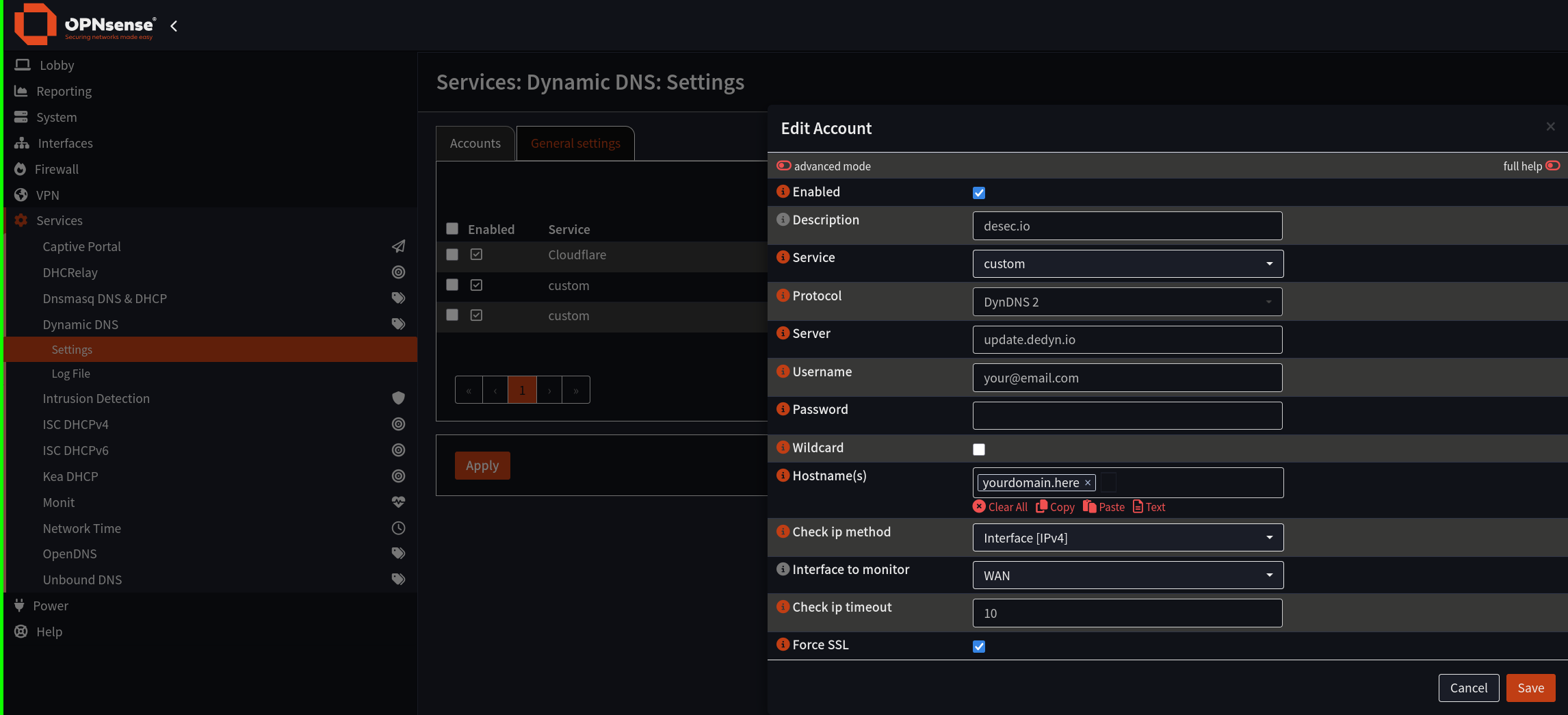
Same. I have a router with OPNsense. In the “Dynamic DNS” section I create a “Custom” service with the DynDNS2 protocol. I type in
update.dedyn.ioas the server address. You need to also get an api key from the desec.io web panel that you input into the username and password fields.Now everytime the router’s WAN ip changes it automatically edits the DNS zone. So instead of going “your server -> DDNS provider -> DNS CNAME record” it’s just “your server -> DNS A record”
I also have a separate token for my web proxy (traefik) so that it can edit the DNS records to get let’s encrypt certificates through dns challenge as you describe.
As for the desec signups in my case one DNS zone was no problem, but for a second one I needed to e-mail them:
Hello, would it be possible for my newly created account to get one more domain on the account please? I have two personal domains and it would be great if I could keep them both under deSEC
Hi [me], Sure! The limit is mostly there to remind users to enable DNSSEC, but it looks like you’re already doing that (at your old provider).
They asked me to (voluntarily) donate, which I did too.
I’ve used no-ip.com for years without issue.
My NAS supports a few services out of the box. If you have anything like that, see what they support natively first.
I’ve been using desec.io since it’s european, non profit and privacy oriented. Bring your own domain though. Works well, although my caddy plugin has problems getting certs sometimes. My pangolin instance never has any issues getting certs so might be caddy desec plugin specific.
desec does offer one free subdomain, and you can use as many nested subdomains as you want for your services. do note you’ll need a wildcard cert for each subdomain level: *.sub.dedyn.io and *.app.sub.dedyn.io if a service needs it’s own subdomains for apis and whatnot.
edit: also a note for any fellow noobs like me it’s deDYN.io not deSEC.io on your account/subdomain. it took me an embarrassingly long time to realize my mistake trying to sign up with every subdomain i tried saying it exists already.
My Domain registrar has a reverse DNS service included.
Anything that supports bind’s built-in nsupdate.